Closed
Alchemist
- 2–8Players
- 75 minutesTime
- Difficult. Dense puzzles. Better with some experience.Difficulty
- Not scary. Almost no tension.Scariness
About the escape room
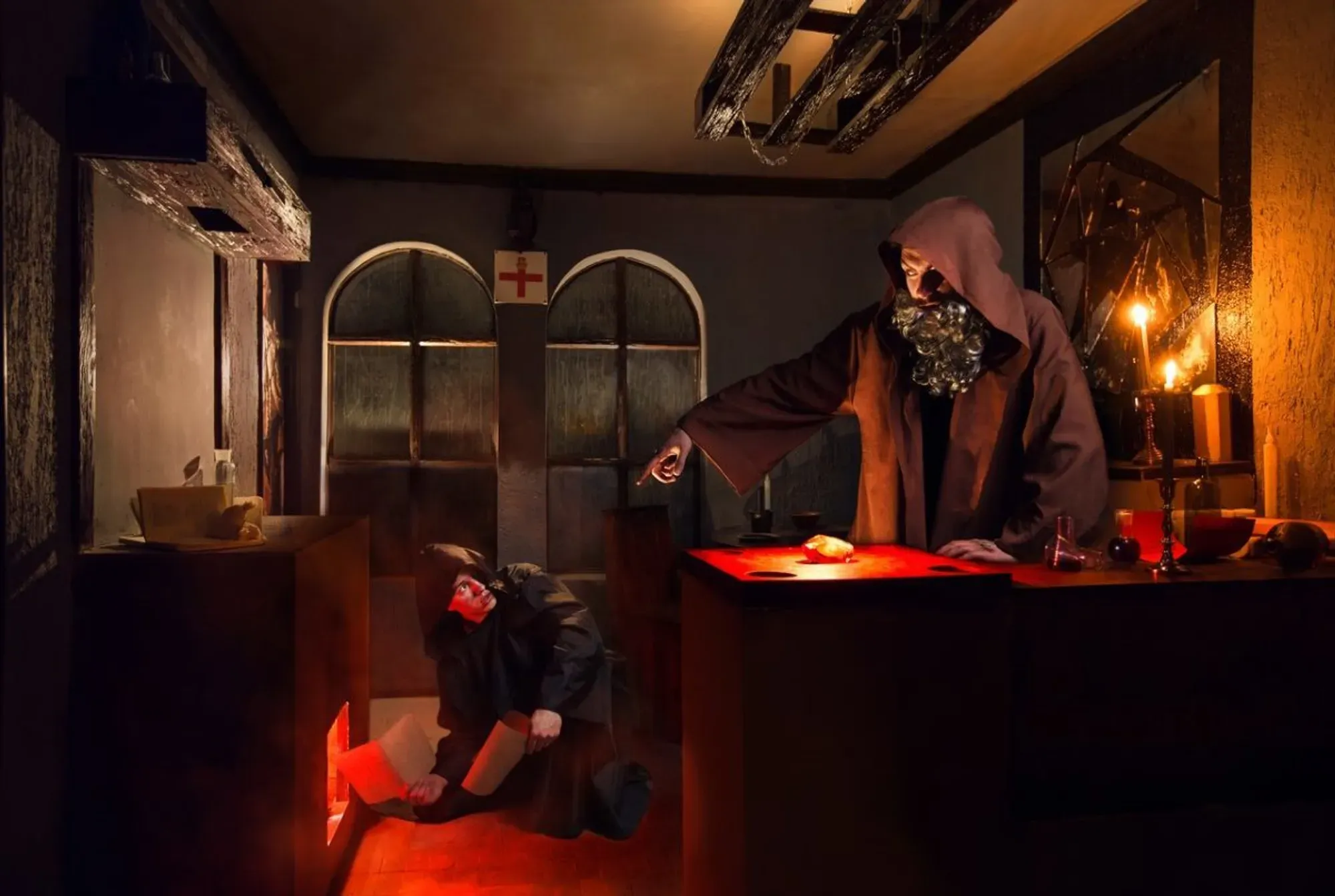
You are chosen members of a secret order, and you have managed to get into the house of alchemist Roger Bacon. The renowned scientist has acquired knowledge on how to produce gold from the philosopher's stone, but his house is about to be set on fire by court knights on the king's orders. You will have exactly 75 minutes to unravel all the secrets of alchemy and save the fate of England.
Important information and features of the escape room
В квесте доступна услуга аниматора и костюмированного аниматора. Стоимость услуги – 1000 и 1500 рублей, соответственно.
The owner of this escape room has not yet confirmed their details.
If you are the owner of this escape room, please confirm your details so that customers can see your contact information for bookings.Location
Рядом с остановкой «Трансагентство»
Services are provided by ИП Ходырев С.Г.
Free Parking
Wifi
Wardrobe
Waiting Area
AI Overview
AIPeople most often praise the setting, music, and varied puzzles, especially the fine-motor stage with a selectable level. Critiques repeat complaints about stuffiness, cramped and dark rooms, and props that are sometimes tired or finicky. The operator usually helps, but sometimes hints unprompted and even triggers mechanics by hand, which breaks immersion. The story is clear, but due to lobby noise or dim lighting the intro can slip by.
WeaknessesHot and stuffy, at times dark and cramped; props are sometimes worn or glitchy. There are non-obvious spots and manual triggers from the operator, which irritate experienced players. Occasional overlaps with children’s parties and noise behind the door.
StrengthsStrong medieval laboratory atmosphere with thoughtful set design and sound. Many logical tasks with minimal searching and satisfying mechanical moments. There’s a choice of difficulty and a sense of progress through locations.
SecurityYou get a briefing before the start and staff monitor the process, helping promptly if needed. Keep the heat and dimness in mind; those sensitive to stuffiness should come light and in small teams.
Level of fearThis isn’t a horror: at times uneasy due to music and semi-darkness, but without scary actors. Suitable for kids and families; schoolkids manage with hints.
Actors' gameNo actors; interaction goes through the operator. Most note friendliness and clear hints, but sometimes help comes too often and breaks the atmosphere.
Quality of riddlesPuzzles are generally logical, diverse, and well woven into the theme, with an emphasis on mechanics and fine motor skills. The difficulty selection is felt, though some tasks may be non-obvious or depend on equipment working. No special chemistry knowledge is required; mixing ingredients is more play than formulas.
PlotYou sneak into Roger Bacon’s house and in 75 minutes try to unravel the secrets of the Philosopher’s Stone to save England. The narrative is delivered without a long prelude and leans on atmospheric transitions between rooms.
Difficulty levelBaseline difficulty is medium, and the motor-skill stage can be tuned to your preference. Beginners are comfortable with hints; experienced players should pick the maximum difficulty and go as 2–4 people, otherwise it’ll feel too easy and cramped.
Other escape rooms at this location
Escape rooms in Yekaterinburg by category
Pick a vibe — every category is a real page with reviews and booking.
Reviews